Donate to the most impactful climate charities
Supporting the world's most cost-effective charities can catalyze the systemic change we need to tackle climate change in 2025.
By Soemano Zeijlmans · Published 7/2025 · Updated 7/2025
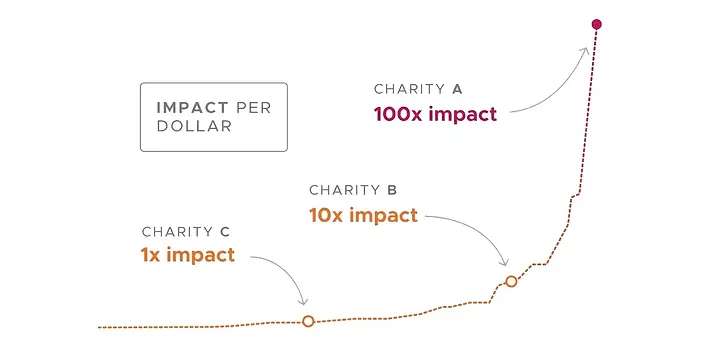
Differences in impact per dollar of charities © Giving What We Can
In this article, we cover:
Why some climate charities are much more impact than others.
Some reasons to consider donating to these effective charities
How independent charity evaluators find the best donation opportunities
The best climate charities as of 2025.
It may seem obvious which climate charities are the best. You probably know a few large, reputable climate charities because of their marketing materials or their news coverage. Your friends and family might be donating to them already. Their messaging is convincing: they have inspiring goals, passionate leadership, and a slick website. If, like many people around the world, are choosing where to donate, it is easy to pick these charities as the default option. And does it really matter to which charity you donate, since there are so many things we need to do to tackle climate change?
That's a common way to think, but it misses an important point: some charities are much more impactful than others. Where you choose to donate your money can make a big difference in the impact that your donations enable. In fact, this difference is so big that donating to the best charities can easily lead to a 100x higher impact.
Which charities you decide to support is an important decision. Luckily, there are independent evaluators that research which charities are the most effective. In this article, we'll cover why some charities are much more impactful than others, how we know which climate charities are the most effective, and some reasons to consider donating to them. Of course, we'll also give you a list of highly effective climate charities, according to independent research.
Why are some climate charities so much more effective?
Compare it to buying a laptop. Everyone knows that there are big differences in the quality and the price of laptops. You probably want to get the best laptop for the lowest price. When you purchase a laptop, you'll probably take a look at the specifications, you might try it out in a store, and you'll even read some reviews from other people online. Once you make a decision, you have a pretty good understanding which one is best, and if you don't like it you can send it back.
Now think of a charity: just like how laptops very widely in price and quality, so do non-profits. Some non-profits are able to achieve much more progress on climate change than others for a lower price. But while we have a pretty good understanding of whether a laptop has a good value-for-money before we buy one, we often have no clue about the value-for-money of a charity before we donate. Often, the only information that we do have come from a charity's marketing department, which isn't a neutral source of information.
A key difference here is that, unlike businesses, charities don't help the people that give them money. Businesses deliver a product or a service to customers, and if customers don't like the product or service, they go out of business. But if a charity is doing ineffective work, they won't go out of business as long as donors are willing to support them.
How do we know which climate charities are most effective?
Because charities differ widely in their effectiveness, it is helpful to follow independent third-party charity evaluators when making a donation. These organisations research which climate charities are most likely to make significant progress, even with small donations. Donating $1000 to highly effective charities is like donating $100,000 to the average charities. If you think twice before you donate, your donations can achieve a profound impact!
We recommend following the giving advice by Founders Pledge and Giving Green. These organisations look for climate change charities that are exceptionally cost-effective. They typically look for evidence of the following:
Does the charity tackle a problem that is very large in scale? For example, does it work on geographies or sectors that cause a large amount of carbon emissions?
Does the charity work on a solution that is feasible? In other words: is it likely that the solution that they're working on is likely to be supported in politics, or are the innovations that they're developing likely to succeed?
Does the charity have a big need for more funding? Often, funding solutions that get little attention by other donors is exceptionally effective, because there's a low chance that the charity would successfully fundraise otherwise.
In practice, this often means that effective charities are working on strategies that have a very high 'leverage'. This means that instead of funding direct emissions reductions (such as offsets), it is usually more impactful to lobby for policy change or accelerate innovations in new climate technologies. For example, spending $1000 to help build a windfarm is probably less effective than spending $1000 on research and development to get new and better climate tech of the ground. Spending $1000 on a lobbying campaign so that the government will spend millions on renewable energy innovation might be even more effective.
Should I donate to high-impact climate charities?
If you live in a high-income country, you're likely among the richest people in the world. For example, if you're a two-person household in the US earning around the median household income ($70,000), you're among the 4% richest people in the world. (You can compare your own income to the rest of the world on the Giving What We Can website.) And yes, that already takes into account that the costs of living in other places are a lot lower.
Donating 10% of your income doesn't sound like it really moves the needle. But when you consider that you're likely among the people with the highest income in the world, and that some charities are exceptionally impactful, you can absolutely make a big impact by donating a small percentage of your income.
This is exactly what a global community of givers does. Nearly 10,000 people have taken the 🔸 10% Pledge, a promise to donate 10% of their lifetime income to effective charities. Or, if you first want to try out how regular giving feels, you can first take a 🔹 Trial Pledge. Pledging helps to keep you excited about giving, but it can also inspire others to start giving to effective charities!
Another reason to donate to high-impact climate charities, is that donating the high-impact charities is the effective lifestyle intervention to tackle climate change. It's even better than avoiding flying, living without a car, or buying green electricity, according to a conservative estimate by Founders Pledge. Of course, we don't want to discourage you from lowering your own carbon footprint, but if there is one lifestyle intervention that you should take, it's donating to effective climate charities.

We recommend donating to charitable funds
Many people donate directly to charities. That's still a great approach. However, we think that donating to an expert-led grantmaking fund is typically better than directly supporting individual charities.
Expert-led funds have several advantages:
Funds can ensure that effective organisations receive the funding they need when they need it most.
Funds can finance individual projects over organisations, when they deem it more impactful.
Funds can change their recipients when the climate landscape evolves or new evidence emerges.
Funds can pool money from many donors and transfer larger amounts that will make a big difference for a charity.
If you donate to an expert-led grantmaking fund, experts continuously assess where your donations can make the biggest difference. We recommend the grantmaking funds by Founders Pledge and Giving Green. Both funds don't take a cut from your donation, meaning that all of the money that you donate will go directly to high-impact charities.

Founders Pledge Climate Fund
Accelerates innovation in neglected technologies
Grows effective climate organisations
Promotes policy leadership

Giving Green Fund
Supports climate policy advocacy
Advances innovative technologies like geothermal, green shipping, and alternative proteins.
Our mission is to help you donate effectively. We do not charge fees to organisations or funds that we recommend. We have selected these funds because they use their research prioritises cost-effectiveness and follows the principles of effective environmentalism. We also recommend giving opportunities tailored to your country for tax-efficient giving.
What are the best climate charities?
If you do decide to donate to high-impact charities directly, or if you want to know which organisations are vetted by charity evaluators, you can find effective climate non-profits below. These are the top nonprofits as evaluated by Founders Pledge and Giving Green as of 2025.

The Clean Air Task Force (CATF) works to accelerate decarbonization by promoting policies and technologies across sectors such as zero‑carbon fuels, transportation, and super‑hot rock geothermal. Giving Green considers them a top nonprofit because of their strong track record in shaping impactful climate legislation and advancing low‑carbon technologies at both national and international levels. With additional funding, CATF would expand global advocacy, support emerging geothermal innovations, and push for stronger policy frameworks around zero‑carbon transport and fuels. Recommended by Founders Pledge and Giving Green.

Future Cleantech Architects (FCA) is a Germany‑based think tank focused on advancing early-stage clean technologies and policy innovation in hard‑to‑abate sectors like heavy industry, aviation, and firm renewable power. Giving Green ranks them highly due to their unique focus on underfunded innovation gaps and their growing influence in shaping EU climate policy. If given more resources, they would hire more technical experts to deepen their policy engagement, especially in industrial decarbonization and energy system transformation. Recommended by Giving Green.

The Good Food Institute (GFI) promotes plant‑based and cultivated meat alternatives as a strategy to reduce emissions from animal agriculture and transform the global food system. Giving Green recognizes them as a top nonprofit because of their cost‑effective approach in boosting R&D, supporting regulatory development, and scaling production of alternative proteins. Extra funding would enable GFI to expand international offices, issue more scientific grants, and increase policy efforts to unlock greater public investment in sustainable proteins. Recommended by Giving Green.

Industrious Labs is a US‑based organization that builds campaigns and coalitions to decarbonize industrial sectors such as steel, cement, aluminum, and landfill methane. Giving Green identifies them as top-tier because they are one of the few groups solely focused on the emissions-heavy industrial sector and have demonstrated strategic leadership. With more funding, Industrious Labs would scale campaigns in global cement and US heating, enhance their analytical capacity, support field-building, and grow their communications and advocacy efforts. Recommended by Giving Green.

Opportunity Green is a UK nonprofit leveraging law, economics, and policy to fill global climate governance gaps, initially targeting aviation and shipping emissions. Giving Green includes them among top nonprofits due to their focus on under-addressed international sectors and their innovative use of legal tools and climate justice frameworks. Additional funding would allow them to build out new campaigns, forge stronger partnerships, and expand their efforts into other high-impact sectors like buildings, agriculture, and steel. Recommended by Giving Green.

Project InnerSpace is working to rapidly scale geothermal energy by mapping global subsurface resources (GeoMap), investing in early-stage ventures (GeoFund), and advocating for supportive policy. Giving Green selected them as one of the most impactful climate nonprofits because of their high potential to unlock zero‑carbon electricity and heat at scale. With increased financial support, they would accelerate global GeoMap development, grow the GeoFund, convene stakeholders, and support policy and startup incubation activities. Recommended by Giving Green.

DEPLOY/US works to build the neglected field of engaging conservative constituencies in the United States on climate and energy. Less than 1% of US climate philanthropy has supported organisations working on right-of-centre climate action, despite the necessity of engaging conservatives on this issue now that Republicans hold both chambers of congress and the presidency. Recommended by Founders Pledge.
Further resources
Organisations that can help:
Giving What We Can helps ordinary people do extraordinary good by donating a percentage of their income to effective charities.
Ark Philanthropy and Ellis Impact help philanthropists create an impactful philanthropic strategy.
We're also happy to answer any questions about donations. Contact us.
Many countries have organisations that help with effective giving. They can help you find effective charities and often know how to give tax-efficiently:
Aotearoa New Zealand: Carbon Critical Net Zero Fund
Belgium (Flanders): Effectief Geven
Canada: RC Forward Climate Change Fund
Estonia: Anneta Targalt Planeedi Heaolu
France: Mieux Donner
India: Impactful Giving
Netherlands: Doneer Effectief Fonds: Klimaat (also in English) and the Tien Procent Club
Poland: Wieçej Dobra
Spain: Ayuda Efectiva
Sweden: Ge Effektivt
Switzerland:
Effectiv Spenden-Fonds: Klima schützen (in German)
Mieux Donner (in French)
Turkey: Etkili Bağış
United Kingdom: Giving What We Can
United States: Giving What We Can